


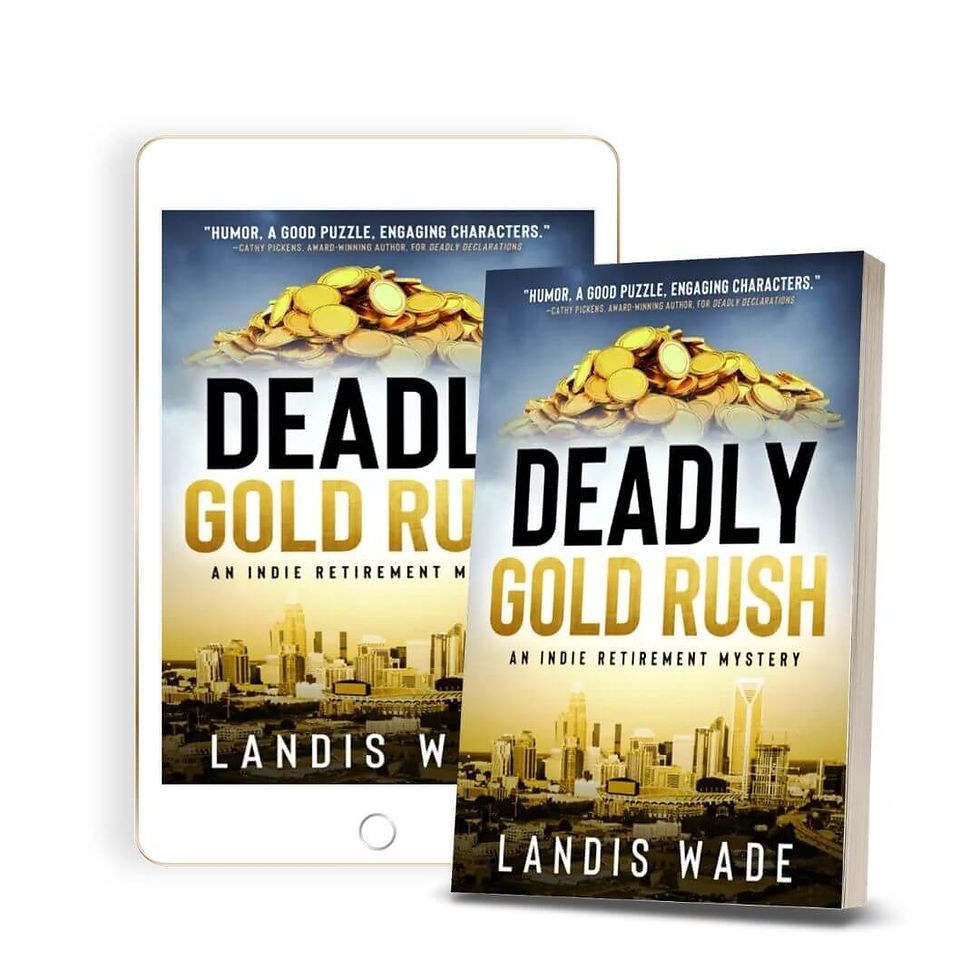
Guest Post, & #Giveaway: Deadly Gold Rush (The Indie Retirement Mystery Series) by Landis Wade
- Archaeolibrarian

- May 29
- 12 min read


Book Details:
Genre: Mystery, Legal Thriller, Historical
Published by: Lystra Books & Literary Services, LLC
Publication Date: March 3, 2026
Number of Pages: 378 pages, Paperback
ISBN: 979-8992136357, Paperback
Series: The Indie Retirement Mystery Series, Book 2


@authorlandiswade @partnersincrimevbt

@landiswrites @partnersincrimevbt


Murder, mines, and missing millions—retirement just got interesting.
When a shady real estate developer is found murdered beneath Harriet Keaton’s family home—shot, stabbed, and surrounded by rare 1830s gold coins—her estranged twin brother Joey is the prime suspect. He insists he’s innocent...but won’t name the real culprit.
With Joey refusing to talk and millions missing from the retirement accounts, the future of the Independence Retirement Community is suddenly on the line. Now, whip-smart Harriet and her sleuthing partners—Craig Travail (savvy lawyer, reluctant romantic) and Yeager Alexander (conspiracy theorist, resident rabble-rouser)—must dig into the past to solve the crime.
Their best lead? A decades-old memoir from Harriet’s treasure-obsessed father and whispers of a long-lost gold hoard.
But treasure has a way of attracting trouble. As fortunes vanish and suspects multiply, the trio must untangle two decades of betrayal—before the killer strikes again.
Murder, mayhem, and the Carolina gold rush: welcome back to the Indie, where retirement is anything but quiet.
Bookshop.org | StoryGraph | Goodreads | Smashbomb | BookBub

available in #KindleUnlimited

Chapter One
Death in the Passage
The narrow alleyway walls muffled the gunshot as uptown Charlotte slept. It was one thirty in the morning on Tuesday, April 1.
The phone call didn’t last long.
“It’s me,” the caller said. “I need your help.”
“I’m listening.”
“I have a body.”
“Whose?”
“Chance Landry.”
“Where are you?”
“Lincoln Street. Inside the Rivafinoli Passage in South End. Next to the Queen Charlotte mural.”
“Anyone with you?”
The caller explained who else was still there.
“You leave. Tell them to stay with the body and wait for my call. I need to think.”
Three minutes later, the call was made to the only living person remaining in the passage who could help.
“I am going to text you an address.” Next, they explained what to do with Landry’s body when they got to the address.
“Are you kidding? He’s already dead.”
But the person giving instructions had no sense of humor. “Just do it.”
A text message followed with the address.
The person who received the message knew how to follow directions and did as they were told.
Chapter Two
Vengeance is Sweet
The 11:15 p.m. email on Craig Travail’s phone read: Your friends are about to suffer financial ruin, untold heartbreak, and trials and tribulations. You have only yourself to blame.
What?
Travail read the email again, slower this time. He read it twice more. There was no author name. Just an unknown vengeance is sweet email address.
Travail exhaled. His email checking practice was a bad habit, a routine held over from his career when clients expected their lawyers to be available 24/7.
Nothing good ever came of his itch to scratch his email in-box for late-night messages, like now, when it would be twice as difficult to sleep after watching the late night local news—with its smorgasbord of crimes, collisions, and natural disasters—and reading this email.
One news story was about elder fraud, a reminder of how susceptible retirees are to financial fraud schemes. Was that what was coming for his friends at the Independence Retirement Community, which everyone called the Indie? Were the residents about to suffer financial ruin because of risky investments? If so, he’d be angry at the perpetrators for their heartless guile and frustrated with his friends for being so gullible.
The television show made the point, though, and he agreed, that adults spend most of their lives collecting assets to make retirement possible and the rest of their days worried if their accumulated treasure will last as long as they do, leading some retirees to make risky and uninformed choices with their nest eggs. Was that what his friends had done? Made bad choices with their money? Is that what the emailer taunted him about?
Travail’s instinct was to fire off a harsh response to the email with some choice lawyer-like words and warnings, but he ignored the bait—he suspected they wouldn’t respond anyway—and he punched the remote control instead.
The television screen faded to black, and his den fell silent, save for Blue’s rhythmic snores and his jerking legs. Travail’s black and tan coonhound must be dreaming, chasing ducks along the lake behind Travail’s cottage, as he was apt to do in real life, and as usual, failing to catch the waterfowl before they darted back into the water. Travail leaned over his club chair’s arm and let his free hand graze on Blue’s back until his pet stopped running in his sleep.
Maybe the email was a prank. Maybe, like him, a friend had become bored with life at the Indie. And yet, the email bothered him.
Whose lives—which friends’ lives—were about to be shattered? And how? And for that matter, why? And what did he have to do with it?
Since moving a year earlier into the Independence Retirement Community, Travail had made two best friends, Harriet Keaton and Yeager Alexander, and several other good friends. He’d met many other retirees, some whose company he tolerated and some whose company he could do without. Either way, he didn’t want to see anyone hurt. He certainly didn’t want his close friends to suffer, and he didn’t want to be the person responsible for their pain.
The flame on the candle he’d lit this morning was down to the base of the wick. He turned away from it, detesting the severe loneliness of March 31.
There was no logic for feeling so alone—what with all the crimes, court cases, and historic mysteries Harriet, Yeager, and he navigated since he arrived at the Indie and the time they spent together—but it was hard to control his feelings, especially the feeling of being by himself. A Jewish resident told him about the tradition of lighting a candle on the anniversary of a loved one’s death. It felt loving to strike the match in Rachael’s honor, but as day became night, Travail’s mood shifted. It had been three years to the day.
The flickering light had a strobe-like effect on the things that reminded him of Rachael: her furniture, her quilts, her artwork, her pictures. Travail missed Rachael’s kindness, her playfulness, her creativity, and the rituals they shared. The flicker made the past too present, making him long for another night and morning and day together. She was here, there, and everywhere, but nowhere at all.
Assertive is what he’d needed to be in the moment that changed everything. He and Rachael were in the mountains at a high-elevation rental for a getaway when a freak storm rolled in and dumped six inches of snow on the ground. Rachael decided to drive to the local general store to stock the pantry for their cozy weekend together. He had a work call and offered to go with her after he finished.
“It’s just snow,” she’d said.
“Okay, but be careful,” he’d responded.
“Always, dear.” Then she kissed him on the mouth, patted his bottom, and walked out of his life forever.
The news came in a phone call from the local police. First came the shock, then the grief, and then the Monday-morning quarterbacking. He should have insisted Rachael let him drive her. He should have done more to protect her. If he had, maybe she would still be here. Maybe the out-of-control delivery truck that hit the black ice would have killed him instead of her, or maybe Travail could have prevented the accident.
Spring in North Carolina was supposed to be about new beginnings, not endings, with the dogwoods and azaleas in bloom, but his eyes grew wet from the memories, and he felt a sudden heaviness in his body.
He looked at the email again and became resolute. For sure, he would not make the same mistake twice with the people he cared about. He would protect them.
But who was behind the email?
Whoever wanted sweet vengeance against his friends wanted vengeance against him too, because their pain would be his pain. The question for his lawyer brain—used to solving riddles for years—was: who despised them and him that much?
Like an unexpected electric shock, the answer startled him. This email was exactly the kind of plot his nemesis, Robert Elkin, would conjure. If Elkin hurt Harriet, Yeager, and his other close friends, he hurt Travail worse.
But wasn’t Elkin no longer a threat? They’d exposed his concealment of the truth about the Mecklenburg Declaration of Independence, avoided death at the hands of his father, pushed him out of his Big Law leadership position, and seen to it that the state bar took his law license. Elkin no longer had big-time lawyer power. The only thing he had was anger, resentment, and a low-paying job as a paralegal with a former client, though Travail didn’t know the client’s name or their business. It was a sharp drop from the level of influence that had made the man dangerous, and yet, there was reason to be cautious. Elkin was cunning and would hold a grudge till death do they part.
Travail leaned his head back in his chair, looked up at the ceiling, and pondered the text again: financial ruin, untold heartbreak, and trials and tribulations.
Harriet was too smart to get caught up in a financial scam. Not so with Yeager. He was impulsive, likely to jump at the chance to possess something shiny because it might become shinier.
Travail pulled an olive-colored sweatshirt over his t-shirt, woke Blue, and took him into the backyard to do his business under the stars. While he waited, Travail glanced across Lost Cove Lake to Harriet’s cottage. He inhaled the fresh night air, and he marveled at the main building’s reflection on the lake’s surface. Harriet’s lights were out. She, an early riser, must be asleep.
Seeing Harriet’s peaceful cottage raised a question he’d been pondering. Should he ask her on a date? Carrie Roberts, the Indie Gossip Queen, thought so and often shared her opinion.
Most days, it seemed like the right decision not to ask Harriet—or anyone else, for that matter—on a date. Three years wasn’t that long, really, since Rachael died. And yet, here he was, caught in a web he’d spun for himself, trapped somewhere between what he no longer had and the companionship he wanted but resisted. Harriet was his friend. Should he keep it that way?
Harriet would most likely turn him down anyway. He was a project, and he knew it, starting with the lesson she’d had to teach him last year that retirement living is not life’s dead end but a fresh path forward. And now, with him being a sixty-six-year-old widower afraid to address his feelings, she’d be quick to beg off.
Blue finished up, and the two headed inside. His watch told him it was a new day. He blew out the dwindling flame on the candle and headed to his bedroom, where Blue was already curled up on the end of Travail’s queen-size bed. Wearing only striped boxers and a white cotton t-shirt, Travail pulled the covers up to his chin. With a good night’s sleep, he’d be fresh in the morning to put his effort into stopping Elkin. He still had his law license, after all, and as Yeager would tell him from time to time, “You ain’t dead yet.”
He closed his eyes and imagined tying a dry fly rig with two nymphs on a dropper line, the key to catching river trout on and below the surface at the same time. This falling-asleep system was better than counting backward from three hundred by threes. It worked its charm in less than five minutes.
Travail didn’t know when he dozed off that the murder train had left the station. He didn’t know when he began to snore that someone had already set the trap for his friends. And he didn’t know when he fell into a deep sleep that when the sun came up, he would ponder, and not for the first time, how he could have been so wrong to believe retirement living would ever be boring or lonely.

How The First US Gold Rush Led to the Novel Deadly Gold Rush
You are probably familiar with the California Gold Rush, but did you know that the first US Gold Rush was in North Carolina?
In 1799, 12-year-old Conrad Reed found a shiny object in a creek on his father’s farm not far from Charlotte, North Carolina. It turned about to be a 17 pound gold nugget, but neither his father nor the local silversmith knew what it was. The family used it for a door stop for three years until a jeweler in Fayetteville, NC bought it for $3.50, only to sell it a week later for $3,000.
When John Reed learned he’d been swindled, he searched for more gold on his property and he wasn’t disappointed. In 1803, a slave named Peter working the farm’s creeks found a 28 pound gold nugget, and gold fever struck the Carolinas.
Between 1803 and 1825, most of the gold processed at the US Mint in Philadelphia came from North Carolina. Miners engaged in placer or surface mining, which meant they dug pits or searched the creeks to find their gold. It wasn’t until the 1820s that someone got the bright idea to dig deeper and follow the vein of gold, leading to underground gold mining and the influx of foreign miners.
I thought it would be fun to work facts from the first US gold rush into a mystery novel. I chose Charlotte, NC as the setting because that is where my fictional amateur sleuths live in a retirement community and because Charlotte had more gold mines in the 1830s than any other county in North Carolina. Some of those mines had interesting names like Black Cat, Queen of Sheba, King Soloman, and Yellow Dog. Charlotte was also selected by Congress and President Andrew Jackson as the location for the first branch of the US Mint in 1837, and during that period at least nine mining companies did business in the area, including the London Mining Company.
The newspapers said Charlotte’s 1830s streets were literally paved with gold due to the golden flecks visible in the crushed ore used as road material. Charlotte was no longer what George Washington called a “trifling place” on his 18th Century Southern tour after the revolution, but not all the press was good. One NY correspondent could “hardly conceive of a more immoral community… Drunkenness, gambling, fighting, lewdness, and every other vice exist here to an awful extent.” A Charleston, SC reporter called the gold the “corrupting treasure.” And yet, the economy prospered, because as Mark Twain once said, “when there is a gold rush, it’s a good time to be in the pick and shovel business.”
Charlotte is now known as a large banking center. When gold came to Charlotte, so did the first bank and the first two newspapers. Foreign miners arrived in 1830, doubling the population. One mine, the Rudisill Mine, is in the heart of uptown, with a gold vein that runs behind where the NFL Carolina Panthers football team plays today. The Rudisill mine was active for over 100 years, but that mine, like all the others, is now silent. It’s 300 foot deep shafts lurk below the surface in the shadow of modern skyscrapers. And yet…
When the mines played out, there were no clean-up or reclamation efforts to protect the public, and from time to time, those mines collapse. A 1960s newspaper article reported that a bulldozer fell into a Rudisill Mine shaft. A local TV station reported that the basement of a house collapsed due to an old mine shaft. These facts gave me the idea for the opening of Deadly Gold Rush: a body tangled in the debris of a collapsed gold mine shaft under a house adjacent to Charlotte’s historic gold district.
When a shady real estate developer is found murdered beneath Harriet Keaton’s family home—shot, stabbed, and surrounded by rare 1830s gold coins—her estranged twin brother Joey is the prime suspect. He insists he’s innocent...but won’t name the real culprit. Murder, mines, and missing millions—retirement just got interesting. Or…Murder, Mayhem, and the Carolina gold rush. Or…Three retirees, Two murders, Zero time for bingo.
In this series, I enjoy mixing history with mystery. I try to make sure the history does not slow the story. I include just enough history to make the reader wonder: Did that really happen? With regard to the history in Deadly Gold Rush, the answer is yes, it really did.



Landis Wade is a recovering trial lawyer turned author who writes award-winning mysteries and legal thrillers with a historical bent. His publication credits include six works of fiction, eight non-fiction writing books, many short stories, and a podcast that produced 400 episodes of author interviews and writing discussions. His first novel in his Indie Retirement Mystery series, Deadly Declarations, won ten awards and Kirkus Reviews said of his second in the series, Deadly Gold Rush, that “Mystery fans who love Richard Osman’s cozy Thursday Murder Club books will enjoy the similarly energetic take on mystery-loving retirees.” Landis splits his time between Charlotte, Durham, and the North Carolina mountains. He is the recipient of the 2025 Founders Award for service to the Charlotte Writers Club and the literary community.
Catch Up With Landis Wade:
Tour hosted by: Partners in Crime Tours



Wow, this was fascinating!!!!
I have a lot of books about the CA gold rush and the AK gold rush, but I didn't know about SC!