


Excerpt: Lucie Dumas by Katherine Mezzacappa
- Archaeolibrarian

- Apr 23
- 5 min read


Book details:
Book Title: Lucie Dumas
Series: n/a
Author Name: Katherine Mezzacappa
Publication Date: 30th March 2026
Publisher: Stairwell
Pages: 236
Any Triggers: This is the story of a 19th-century prostitute and her attempts to escape the streets, but it is not in any sense explicit. There is some reference to the physical effects of syphilis, a rape (but not in detail, simply that it happened) and to a client’s proclivity for physical punishment. The book quite definitely does not take the form of a ‘tell-all’ memoir. It’s a story of survival at a time when ‘fallen’ women were urged to mend their ways but left with precious few avenues by which to achieve this.


@katherinemezzacappafiction @thecoffeepotbookclub

@katmezzacappa @thecoffeepotbookclub


London, 1871: Lucie Dumas of Lyon has accepted a stipend from her former lover and his wife, on condition that she never returns to France; she will never see her young son again. As the money proves inadequate, Lucie turns to prostitution to live, joining the ranks of countless girls from continental Europe who'd come to London in the hope of work in domestic service.
Escaping a Covent Garden brothel for a Magdalen penitentiary, Lucie finds only another form of incarceration and thus descends to the streets, where she is picked up by the author Samuel Butler, who sets her up in her own establishment and visits her once a week for the next two decades. But for many years she does not even know his name. Based on true events.

Bookshop.org | StoryGraph | Goodreads | Smashbomb | BookBub


I have been a femme entretenue, a flagellant, a penitent, a streetwalker, an inhabitant of night houses, a demimondaine. In some of these manifestations I have passed sometimes as one of my respectable sisters. But whatever I have been called, I am a whore. The rules are different for such as I.
To begin with I would look from the window when a gentleman was leaving, to see Brigid waiting patiently at the corner, but deliberately far from a streetlamp even on dark days. Another ten minutes would pass before she came up. She told me it was because she did not want to see me in déshabillée, not at five o’clock in the afternoon. I told her that English gentlemen expect to be helped into their coats by her, and their walking sticks and hats handed to them by someone wearing a maid’s apron. It was quite a different matter when she had the dressing of me at nine in the morning, because I passed my nights alone. It is some time since I have woken up beside a man; not since that house in Covent Garden. I would not want the baker to encounter any of my callers on the stairs, nor they any of the baker’s little children on their way to Princes Street Board School. Besides, my callers are usually expected at home for dinner.
It is from Mr Jones that I first heard about Miss Savage, who wanted to marry Monsieur, only Miss Savage was plain and walked with a limp and in any case Monsieur did not wish to be wed. I was relieved at this, though I felt sorry for the poor lady too. It is not that I ever thought Monsieur would marry me. This I learned early on in Paris. Not even the presence of my little boy – our little boy I should say – was any guarantee of his father’s affection. That I am in London at all is only because it was the sole means I had of ensuring that my Théodore should be provided for – provided for on pain of never seeing his mother again. Am I a mother still? I have no idea. I do not know if Théodore lives. All I know is that in relinquishing him, he may have had a chance at life. No, I am a woman no gentleman would wed, though when I paced Islington with Elise and Rachael the greater part of the men who followed me up to that dingy room wore a wedding ring or had the indent on a finger to show that a ring had been hastily removed (this I think was more about a struggle with their own consciences than any consideration of my thoughts on the matter). You see, if Miss Savage were to have wed Monsieur I could well have been dismissed, and if I wasn’t, and Miss Savage found out about me, then knowledge of my existence would have reduced her maiden dreams to ashes. A woman of my position in life is always expected to be mindful of the sensibilities of respectable ladies. We are to know of their existence, but they are not to know of ours. Any sufferings of my own moreover must be borne in silence, for not only do I no longer have Elise or Rachael to confide in, but a woman of my character has foregone the right to womanly feelings. So the nuns in that refuge told me, anyway.
Miss Savage died, and of course Monsieur was filled with remorse. He came to visit me by his usual appointment, but remained in his chair, one hand atop another, and talked at me about her for an hour. I was not required to do anything but emit the occasional sound to indicate that I listened. He got up, thanked me, and told me he would let himself out.
I wondered if he would come back. He did. I wondered too if anyone would speak of me when I am dead. But to whom?
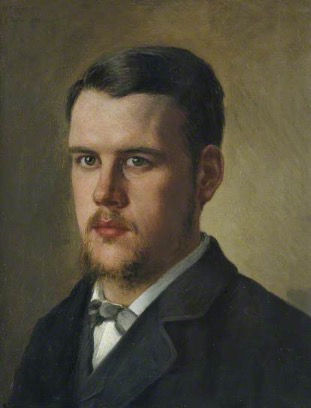
Illustrations: Lucie’s two long-term lovers, Samuel Butler and Henry Festing Jones


Katherine Mezzacappa is Irish but currently lives in Carrara, between the Apuan Alps and the Tyrrhenian Sea. She wrote The Ballad of Mary Kearney (Histria) and The Maiden of Florence (Fairlight) under her own name, as well as four historical novels (2020-2023) with Zaffre, writing as Katie Hutton. She also has three contemporary novels with Romaunce Books, under the pen name Kate Zarrelli.The Maiden of Florence was shortlisted for the Historical Writers’Association Gold Crown award in 2025 and has also been published in Italian.
Katherine’s short fiction has been published in journals worldwide. She has in addition published academically in the field of 19th century ephemeral illustrated fiction, and in management theory. She has been awarded competitive residencies by the Irish Writers Centre, the Danish Centre for Writers and Translators and (to come) the Latvian Writers House.
Katherine also works as a manuscriptassessor and as a reader and judge for an international short story and novel competition. She has in the past been a management consultant, translator, museum curator, library assistant, lecturer in History of Art, sewing machinist and geriatric care assistant. In her spare time she volunteers with a second-hand book charity of which she is a founder member.
She is a member of the Society of Authors, the Historical Novel Society, the Irish Writers Centre, the Irish Writers Union, Irish PEN / PEN nahÉireann and the Romantic Novelists Association, and reviews for the Historical Novel Review. She is lead organiser for the Historical Novel Society 2026 Conference in Maynooth, Co. Kildare.
Katherine has a first degree in History of Art from UEA, an M.Litt. in Eng. Lit. from Durham and a Masters in Creative Writing from Canterbury Christ Church.
Author Links:
Website: https://katherinemezzacappa.com/
Instagram: https://www.instagram.com/katmezzacappa/
Amazon Author Page: https://www.amazon.co.uk/stores/Katherine-Mezzacappa/author/B0B8KJQ7GQ
Tour hosted by: The Coffee Pot Book Club




Thank you so much for hosting Katherine Mezzacappa today, with such a fabulous excerpt from her enthralling new novel, Lucie Dumas. We appreciate your support. Take care, Cathie xx The Coffee Pot Book Club