


Guest Post: Renaissance Rivals by Karen Essex


Book details:
Book Title: Renaissance Rivals
Series: Sequel to Leonardo’s Swans
Author Name: Karen Essex
Publication Date: July 18, 2026
Publisher: Kleopatra Books
Pages: 311
Genre: Historical Fiction
Any Triggers: Child loss; miscarriages.


@KarenEssexAuthor @thecoffeepotbookclub

@karenessex @thecoffeepotbookclub

#TheCoffeePotBookClub #BlogTour #WomenOfHistory #RenaissanceWomen #IsabelladEste #LucreziaBorgia #RenaissanceItaly


Renaissance Rivals, the long-awaited sequel to the global bestseller Leonardo’s Swans, brings to life the brutal rivalry between two of history’s most fascinating women: Isabella d’Este, Marchesa of Mantua, celebrated in her own lifetime as “The First Lady of the World,” and Lucrezia Borgia, Duchess of Ferrara, daughter of the infamous Pope Alexander VI and one of the most maligned women in history.
Before the doomed duchess of Maggie O'Farrel's The Marriage Portrait, there were women who built the courts, forged the alliances, and turned power into art. Renaissance Rivals invites readers to step back one generation into the glittering, dangerous world that shaped the Italy of Leonardo da Vinci, Raphael, and Niccolò Machiavelli.
Pitted against each other by the ruthless political landscape and by the men they loved, Isabella and Lucrezia must learn how to survive in a world where women are treated as prizes, pawns, and weapons. Their battle is intimate, brilliant, and borders on the fatal, a war fought with jewels, letters, seduction, betrayal, and the strategic intelligence of women who refuse to disappear.

Bookshop.org | StoryGraph | Goodreads | Smashbomb | BookBub

available in #KindleUnlimited
For paperback orders: https://shop.karenessex.com

Jewels, Letters and Poison: The Weapons of Renaissance Women
by Karen Essex
When we think of weapons in Renaissance Italy, we tend to imagine swords, daggers, crossbows, and armies thundering across the peninsula.
The women at the heart of Renaissance Rivals possessed few of those conventional weapons. Isabella d’Este and Lucrezia Borgia lived in a world where formal power belonged almost entirely to men. Neither woman commanded an army in her own name nor could inherit the principal throne of her family. Both were married to serve political alliances negotiated by fathers, brothers, popes, princes, and dukes.
Yet Isabella and Lucrezia were far from powerless. They fought with the weapons available to them: jewels, clothing, letters, alliances, reputation, fertility, and the affections of powerful men. I call these tools soft power. In fact, they can be as forceful and effective as hard power.
Yet the one tool they did not use was the one hovering over the Borgia world, the most notorious weapon of all: poison.
Jewels and Dress
I was trained as a costume designer and worked early in my career designing costumes for film, still photography, and commercials. Clothing both historical and contemporary has remained one of my great passions, so I could never treat dress in Renaissance Rivals as mere decoration.
In the Renaissance courts, clothing was political communication. A woman’s gown announced her wealth, lineage, marital status, family alliances, and proximity to power. Colors, fabrics, embroidery, pearls, gemstones, and even the shape of a sleeve carried meaning. The arrival of a noblewoman at court could be studied as closely as the arrival of an ambassador.
Isabella’s style, in fact, elicited such fascination that Venetian dollmakers created Isabella dolls to be passed around Europe’s courts to show what the Marchesa was wearing.
Court correspondents reported in vivid detail what important women wore. They described the fabric of a gown, the cut of a bodice, the headdress, and the jewels sewn into sleeves. Those sleeves could become astonishing works of art, detachable and transferred from one gown to another.
As I learned when researching Leonardo’s Swans, the prequel to Renaissance Rivals, Leonardo da Vinci himself was sometimes tasked with designing sleeves and other elements of court dress for Italy’s most exalted noblewomen. A genius we now associate with the Mona Lisa, The Last Supper, flying machines, anatomy, and engineering also turned his imagination to fashion.
Because they were so heavily bejeweled, official ceremonial gowns could weigh thirty pounds or more, over 13.6 kilograms. Considering that many women of the era stood somewhere around five feet tall, one marvels at how they carried the weight of velvet, brocade, metal thread, pearls, gemstones, elaborate sleeves, and long trains while maintaining the stately grace expected of them.
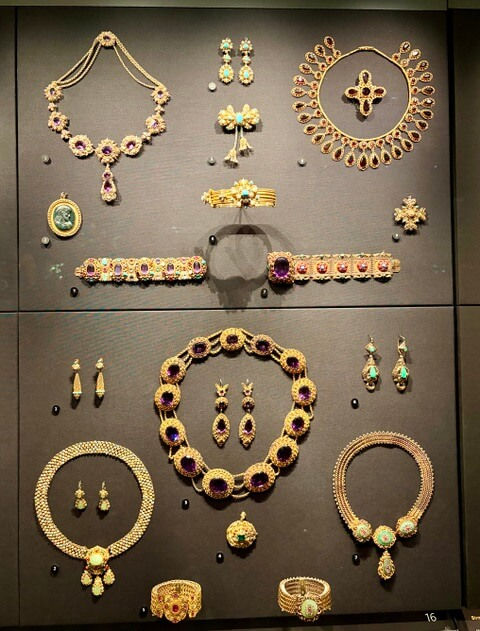
Researching this world required more than studying portraits. I spent many afternoons at London’s Victoria and Albert Museum examining its exquisite jewelry collection, making sure that the pieces I described belonged to the period and that I understood how they were constructed and worn.
Jewels were portable wealth, though their importance extended far beyond their monetary value. They passed through families as inheritances. They represented ancestry, legitimacy, office, and rank. A woman wearing a celebrated family jewel publicly asserted her place within a dynasty as well as a symbol of stature and position.
That symbolism becomes a source of fury for Isabella d’Este.When Lucrezia Borgia married Isabella’s brother Alfonso and entered the Este family, she gained access to jewels once worn by the late duchess. Isabella regarded herself as the rightful heiress to those treasures and vowed revenge upon Lucrezia for wearing them.
Isabella did not need the gems or the money. What enraged her was the meaning of the jewels. To see Lucrezia adorned in them was to see an outsider publicly clothed in Este prestige. Lucrezia was not simply wearing a necklace or fastening gemstones to her sleeves. In Isabella’s eyes, she was appropriating a legacy.
A jewel could therefore become a declaration of war.
Letters

I could not have written Renaissance Rivals without the enormous body of letters left behind by Isabella, Lucrezia, and the courtiers, diplomats, secretaries, relatives, and political observers surrounding them. Indeed, letters to Isabella from Machiavelli himself are a key part of the narrative.
Isabella was a prodigious correspondent. Her letters reveal her intellect, ambition, anxieties, political calculations, and astonishing attention to detail. She wrote about wars, money, art, fashion, diplomatic appointments, horses, jewels, insults, and favors. A great strategist, she also lightly perfumed her letters to important gentlemen, knowing the scent would entice them to read the missives.
Lucrezia’s surviving correspondence allows us to glimpse a woman very different from the depraved poisoner of legend. We see a wife, mother, political intermediary, property manager, patron, and duchess navigating a dangerous world. She also made the mistake of writing letters of affection to a man who was not her husband, letters that fell into the hands of her opponent, Isabella.
Though Isabella sometimes intercepted letters through covert means, court letters were not private communications in the modern sense. They conveyed information, though they also established status and shaped reputation. Many were expected to be copied, shared, read aloud, or circulated through the courts as evidence of what was happening in the political and social landscape.
A correspondent describing a royal entrance or wedding ceremony was recording more than spectacle. Who entered first? Who sat closest to the ruler? Which woman wore the grandest jewels? Who was greeted warmly, and who was conspicuously ignored? Every detail might communicate a shift in status or allegiance.
This knowledge affected how people composed their letters. A writer might flatter the recipient while knowing that several other people would eventually read the words. A letter could cultivate an ally, issue a warning, defend a reputation, or circulate gossip.
For Renaissance women, correspondence created an extraordinary network of influence. Letters could travel where women could not. They entered council chambers, military camps, papal apartments, and foreign courts. Through them, Isabella and Lucrezia negotiated, persuaded, pleaded, demanded, and occasionally deceived—sometimes each other. Their words were indeed weapons sharpened by politeness and courtesy.
Poison
And then there was poison. I became skeptical of poison stories in history while researching my first novel, Kleopatra, when I could not find a single reliable source to support her alleged expertise with poisons.
Poison was sufficiently feared in Renaissance Italy that sudden illnesses and convenient deaths often produced immediate suspicion. Courts employed food tasters, guarded kitchens and wine cellars, and worried about powders, potions, medicines, and contaminated cups.
Lucrezia Borgia became indelibly associated with poison, yet there is no evidence that she used it to murder anyone. Her supposed poison ring belongs to legend, not history.
The darker allegations generally surrounded her father, Pope Alexander VI, and her brother Cesare. One famous story claimed that the Borgia men intended to poison a wealthy cardinal and seize his property to finance Cesare’s seemingly endless military campaigns. According to versions circulated by hostile contemporaries and repeated by later chroniclers, a servant confused the wine vessels at a banquet. Instead of serving the poisoned wine only to the intended victim, he poured it for Alexander and Cesare as well.
All three men reportedly became violently ill. The pope died, while Cesare survived but never fully recovered his health.
It is a magnificent story, but it is highly disputed. Alexander may have died from malaria or another fever common during the Roman summer. The poisoned-wine account grew in the fertile soil of Borgia notoriety, where almost any depravity seemed plausible to their enemies.
For a novelist, the uncertainty is irresistible.
Poison in Renaissance Rivals functions not simply as a method of murder, but as an atmosphere. It represents the fear that danger may be concealed beneath elegance.
Neither Isabella nor Lucrezia needs poison to be dangerous. Their sharper weapons are their intelligence, endurance, and command of appearances. They understand that a gown can declare rank, a jewel can claim inheritance, and a letter can cross borders to alter a life.
In a world that denied women swords, they learned to make weapons of everything else.



Karen Essex is the national and international bestselling author of RUN, DARLING, KLEOPATRA, PHARAOH, LEONARDO'S SWANS, STEALING ATHENA, DRACULA IN LOVE, AND BETTIE PAGE: LIFE OF A PINUP LEGEND. All feature iconic women—powerful women that seduced the world and ruled it.
Essex is also an active screenwriter and speaker, and an award-winning journalist. She divides her time between Los Angeles, New Orleans, and Europe. Her novels are published in twenty-nine languages.
Leonardo’s Swans, the prequel to Renaissance Rivals, was a runaway bestseller in Italy and won the prestigious Premio Roma for Foreign Fiction.
Author Links:
Website:https://www.karenessex.com
Twitter / X:https://x.com/KarenEssex
Instagram:https://www.instagram.com/karenessex/
Pinterest:https://www.pinterest.com/karenessex/
Amazon Author Page:https://amzn.to/44OrSh5
Follow Karen’s Substack newsletter, History. Sex. Power: https://substack.com/@karenessex
Tour hosted by: The Coffee Pot Book Club


Thanks so much for hosting Karen Essex, with such a fascinating post linked to her intriguing novel, Renaissance Rivals. We appreciate your time. Take care, Cathie xx The Coffee Pot Book Club