


Guest Post: Soldiers of Christ (The Northern Crusader Chronicles #2) by Jon Byrne


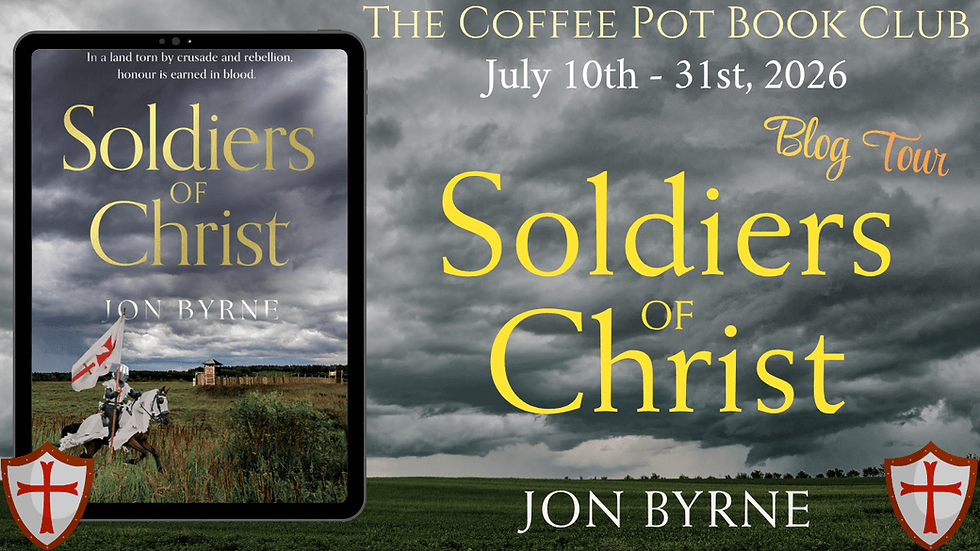
Book details:
Book Title: Soldiers of Christ
Series: Book 2 of The Northern Crusader Chronicles
Author Name: Jon Byrne
Publication Date: 28th April 2026
Publisher: The Book Guild
Pages: 388
Genre: Historical adventure
Any Triggers: Mild swearing, medieval battles, some violence


@JonByrneAuthor @thecoffeepotbookclub

@thecoffeepotbookclub @yardereviews


In a land torn by crusade and rebellion, honour is earned in blood.
1205. Richard Fitz Simon has fled England after his title was usurped, joining the Livonian Order of Swordbrothers – a German brotherhood of warrior-monks fighting to bring the word of God to the pagan frontier. After slaying the Lithuanian champion at the Battle of Rodenpois, Richard is celebrated by the Order and their Semigallian allies.
Yet his position remains precarious. Jealous rivals question his right to stand among the brotherhood, and his master, Knight-brother Rudolf, is enraged by Richard’s disobedience. When dark secrets from Lübeck resurface, Richard also finds himself at odds with Bishop Albert, head of the Christian mission in Livonia. As he struggles to reconcile faith, duty and identity, he is drawn into a brutal world of suspicion, hardship and bloodshed.
Sent on an expedition to build a castle deep in the wilderness, Richard soon sees tensions erupt – and the path he has chosen threatens to destroy everything he has fought to become.

Bookshop.org | StoryGraph | Goodreads | Smashbomb | BookBub


Why the Northern Crusades need their own fictional series
When most readers hear the word ‘Crusades’, they immediately think of Jerusalem, the Holy Land, and the clash between Christian and Muslim armies beneath a burning eastern sun. It’s a setting that has dominated both historical scholarship and popular fiction for generations. There are probably dozens of book series covering this period, and it attracts a steady readership of people who like a bit of action and adventure in their historical fiction. Yet in the early 13th century, far to the north – across the forests, rivers, and frozen frontiers of the Baltic, a vastly different kind of crusade was unfolding.
The Northern Crusades, fought between the late 12th and early 14th centuries, remain one of the most underexplored yet dramatically rich periods in medieval history. And more importantly for readers and writers alike, they offer something the traditional crusading narratives often cannot: a sense of discovery and raw, untamed storytelling potential. This is precisely why they deserve not just a story or two, but an entire fictional series dedicated to them. A single novel could only capture a fragment of the larger story. But across multiple books, it allows the writer to explore the long-term consequences of conquest and conversion.
Unlike the well-documented and widely written campaigns in the Levant, the Northern Crusades took place on the edges of the known medieval world. Livonia, Prussia, and the Baltic regions were lands of dense forests, marshes, and scattered tribal societies that were pagan in belief.For fiction, this creates an atmosphere that feels both familiar and new. In the harsh weather of the location, especially the brutal winters, the land itself becomes an unforgiving character in the story.
The Baltic world was not empty. It was inhabited by diverse peoples with their own traditions, beliefs, and social structures. Alongside the local pagans, there were German crusaders, Danish and Swedish forces, merchants from the emerging Hanseatic League, and Orthodox Russians pushing their own political and spiritual agendas. The depiction of these different people has been sorely lacking in medieval fiction
And what I think makes the Northern Crusades particularly compelling is their moral complexity. In the Holy Land, the conflict is often framed as a clash between two established religions and cultures. The crusaders were there to reclaim the holy places depicted in the Bible. However, this was not the case in the Baltic. The situation was far less clear-cut.
Crusading orders such as the Livonian Brothers of the Sword and later the Teutonic Knights confronted a patchwork of pagan tribes, local leaders, and neighbouring Latin Christian powers, as well as Orthodox Russian principalities. Alliances shifted constantly. Today’s ally could be tomorrow’s enemy.
This ambiguity is fertile ground for fiction. There are no simple notions of right and wrong. A knight may have believed he was saving souls while participating in brutal campaigns of expansion where hundreds of innocent people were butchered. A local chieftain may have initially resisted conversion but ultimately changed his mind to preserve the future of his tribe – converting to Christianity out of necessity rather than a willingness to embrace the one God. Even within the crusading forces, divisions of ambition, faith, and survival created internal tensions.
Many people have never heard of these obscure crusades, and it allows them to discover this new world alongside the characters. I hope this freshness extends to the tone of the story as well. The Northern Crusades lend themselves to grittier, more intimate narratives. The scale was smaller than the great campaigns of the Holy Land, but the stakes were intense. Survival, loyalty, faith, and identity were constantly in question.
For writers, this provides a chance to break away from the familiar and explore something new. For readers, they offer an experience that is both educational and deeply immersive.In a literary landscape where originality is prized but often elusive, the forests and swamps of the Baltic remain largely untouched – a forgotten frontier.
In a genre saturated with knights, castles, and well-worn medieval tropes, originality is increasingly difficult to achieve. The Northern Crusades offer a rare opportunity to present something that feels genuinely fresh while still grounded in historical reality.
The Northern Crusader Chronicles is a glimpse into this fascinating world and serves as an alternative backdrop to the better-known crusader narrative. It tells the story of Richard Fitz Simon, a Norman noble in exile. The tale begins in Sword Brethren, where the older Richard is a captive of Prince Alexander Nevsky after the Battle on the Ice. He begins to write a chronicle, detailing his flight from England aged fourteen, time spent in Lübeck and initiation into the Order of Swordbrothers. The story continues in Soldiers of Christ, detailing Richard’s further adventures, conflicts and religious doubt.
I am currently finishing the third book in the series, but the story will not end there.



Jon Byrne, originally from London, now lives with his German family by a lake in Bavaria with stunning views of the Alps. As well as writing, he works as a translator for a local IT company and occasionally as a lumberjack. He has studied the medieval world for over twenty years, building up a comprehensive personal library and a particular interest in the often-overlooked Northern Crusades.
Soldiers of Christ is Book Two of The Northern Crusader Chronicles, a gritty, historically grounded series focused on realism, moral ambiguity, and the brutal realities of medieval warfare.
Written for readers who value authenticity and atmosphere over romanticised adventure, the novel explores a largely forgotten crusading frontier, culminating in the first of many confrontations in a harsh wilderness of forest and swamp.
Readers who enjoy the historical detail of authors such as Bernard Cornwell, Conn Iggulden, or Ben Kane may find familiar ground here.
Author Links:
Website: https://www.jonbyrnewriter.com/
Facebook: https://www.facebook.com/JonByrneAuthor
Amazon Author Page: https://www.amazon.co.uk/stores/author/B0DJC6PL8D
Tour hosted by: The Coffee Pot Book Club


Thanks for publishing my guest post. Jon
Thank you so much for hosting Jon Byrne today, sharing such an insightful article linked to his compelling medieval adventure, Soldiers of Christ. We appreciate your time.
Take care,
Cathie xx
The Coffee Pot Book Club