


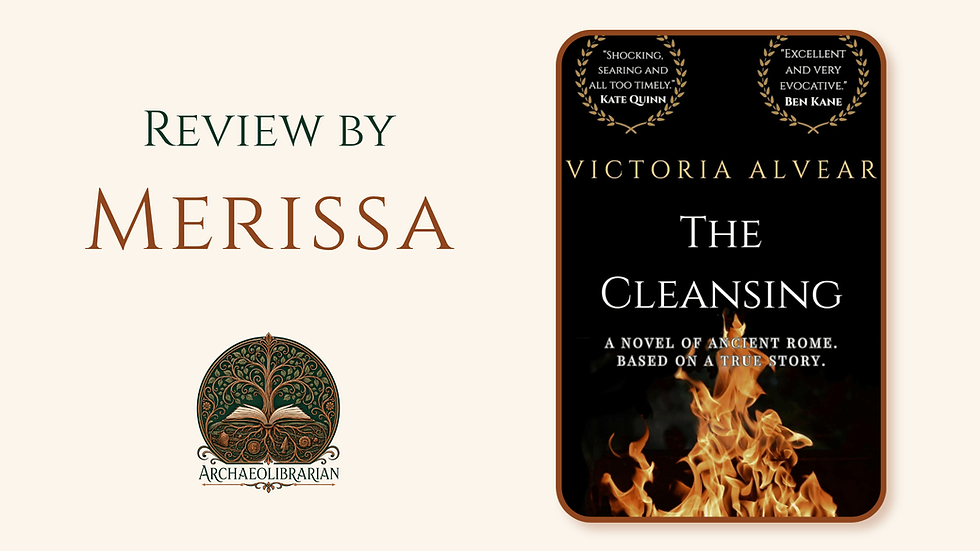
The Cleansing by Victoria Alvear




@vicky_alvear_shecter


Based on a true story, this is not the enlightened Rome of myth. This is a city choking on fear, where blood flows on both the battlefield and altar, and where generals and politicians alike are desperate to appease rageful gods.
When 50,000 Romans fall in a single day at the Battle of Cannae, priests claim there can be only one reason the gods abandoned Rome: a Vestal Virgin has broken her vow of chastity. And they accuse Opimia (Mia), the strongest, most defiant of the six sacred Vestal priestesses.
Forced as a child into serving Vesta, the goddess of fire, Mia has always chafed against Rome’s control of her every move—especially after being separated from her childhood love, Attius. Now, accused of a crime she did not commit, she must defend herself in a hostile court to avoid being buried alive for her “crime.”
Betrayed by the high priestess, hunted by Rome’s political and religious elite, Mia must either accept her fate — or join with the Sybil of Cumae to expose the truth behind a world built on superstition, fear, and lies.
A story of personal awakening amid public catastrophe, The Cleansing is a haunting journey through a city at war with itself — and a woman who risks everything to survive it.
Bookshop.org | StoryGraph | Goodreads | Smashbomb | BookBub

available in #KindleUnlimited

5 out of 5 (exceptional)
THE CLEANSING is a work of fiction that is based on an amalgamation of recorded stories (unfortunately). It's set in a time when women paradoxically had no power, and yet were held accountable for powerful acts. It is also the time when Rome was fighting Hannibal and his elephants, suffering a crushing defeat in the process.
Mia was best friends with Attius until she was 'chosen' at six years old to serve a 30-year term as a Vestal Virgin. This isn't something she wants, as she wants to be like Diana, the Huntress. Being demure doesn't come easily to her. Attius follows his own path, which leads him to the Roman infantry, fighting under General Paullus.
After the defeat at Cannae, the Romans were desperate to blame someone. General Varro has done what he can to blame the now-deceased General Paullus, but they need something else. Something for the Roman people to get behind. They need a sacrifice.
Through the 'current' time and a series of flashbacks, we see Mia grow into her role, and the political machinations that lead to her being accused. While she didn't want to be a Vestal Virgin, she also wasn't prepared to take any chances; although she could be persuaded to bend the rules, as with Prisca. While history has recorded a different ending for Opimia, I loved the version in this book!
There is an amazing supporting cast of characters, from Floronia and Prisca, to the Virgo Maxima, Lucius Cantilius, and Cornelius Lentulus. One of my favourite characters (and places) was the Sibyl of Cumae. I thought she raised some interesting points, and the commune was fantastic.
The research for this book is in-depth and fascinating, so please ensure you read the Author's Note and the Historical Notes. I also read them simply because I wasn't ready for the story to end. This was an outstanding read that held my attention from beginning to end. HIGHLY RECOMMENDED by me.
** The same worded review will appear elsewhere. **
* A copy of this book was provided to me with no requirements for a review. I voluntarily read this book; the comments here are my honest opinion. *
Merissa
Archaeolibrarian

Why Should We Care About Something that Happened 2K Years Ago?
By Victoria Alvear
A true story about a woman everyone wanted to put to death because she supposedly had sex? And her sexuality being blamed as the “reason” why Romans lost a major battle? Our first impulse is to laugh at the absurdity. We think, no way that could happen today. And yet, if we scratch the surface, we find examples of similar tendencies all around us.
My fascination with this ancient true story—which occurred more than two thousand years ago during the war with Hannibal—began when I noticed fundamentalist preachers blaming certain people’s sexuality as the “reason” why storms devastated the land. Reverend Jerry Falwell blamed a hurricane that hit Florida in the 1990s on “lesbians.” Televangelists blamed Hurricane Katrina in 2005 in New Orleans on the fact that the city was planning on hosting a major regional Gay Pride festival that year.
In 2017, a pastor blamed a devastating hurricane in Houston on God’s retribution for the city’s “pro-homosexual mayor.” And in 2020, multiple fundamental Christian leaders blamed gay marriage for the COVID pandemic!
In other words, modern religious leaders continued to claim God “smites” entire regions because he gets angry about the sexuality of a few. How was that any different than the Romans blaming a battle loss on a Vestal Virgin having sex?
I wrote THE CLEANSING to explore this direct connection. I was shocked at how relevant the ancient story was to today’s sexual politics. Only these days, it isn’t Virgin priestesses who are blamed anytime some kind of disaster occurs—it’s gay people. But that’s only in America. In other regions of the world, women continue to be blamed for tragedies because they were either unveiled, not modest enough, or (I’m not making this up) laughed too loudly in public spaces.
The events I cover in THE CLEANSING really occurred, and I wanted to explore how that must have played out. The religious gaslighting, the fearmongering, and the scapegoating of the vulnerable felt very familiar. Unsettlingly so. I also wanted to explore what it would have been like for a woman blamed for the loss at Cannae after she had spent her entire life being told that if she wasn’t perfectly “pure,” the gods would punish countless innocents, including the people she loved.
What must that have felt like? And how might she have survived the accusation?
Nearly two dozen Vestal Virgins were put to death in ancient Rome—almost always after some kind of terrible disaster—famine, war, or pestilence. Holding up a mirror to modern sexism, prejudice, gaslighting, and scapegoating shows us just how easily fear can turn us back into superstitious Romans doing the unthinkable.


Victoria Alvear aka Vicky Alvear Shecter is the author of multiple books set in the ancient world. She writes for adults as Victoria Alvear and for children as Vicky Alvear Shecter. Her adult novels include THE CLEANSING: BASED ON A TRUE STORY, which tells of the true story of a Vestal Virgin falsely accused of having sex and facing a death sentence. Others include A DAY OF FIRE: A NOVEL OF POMPEII, A SONG OF WAR, and A YEAR OF RAVENS. Her YA novels include CLEOPATRA'S MOON, based on the life of Cleopatra's only daughter, and CURSES AND SMOKE: A NOVEL OF POMPEII. She has written a mid-grade series on mythology (ANUBIS SPEAKS, HADES SPEAKS, and THOR SPEAKS) as well as two award-winning biographies for kids. She is a docent at the Michael C. Carlos Museum of Antiquities at Emory University in Atlanta.


Comments