


Guest Post: The Lark by Laura C. Rader


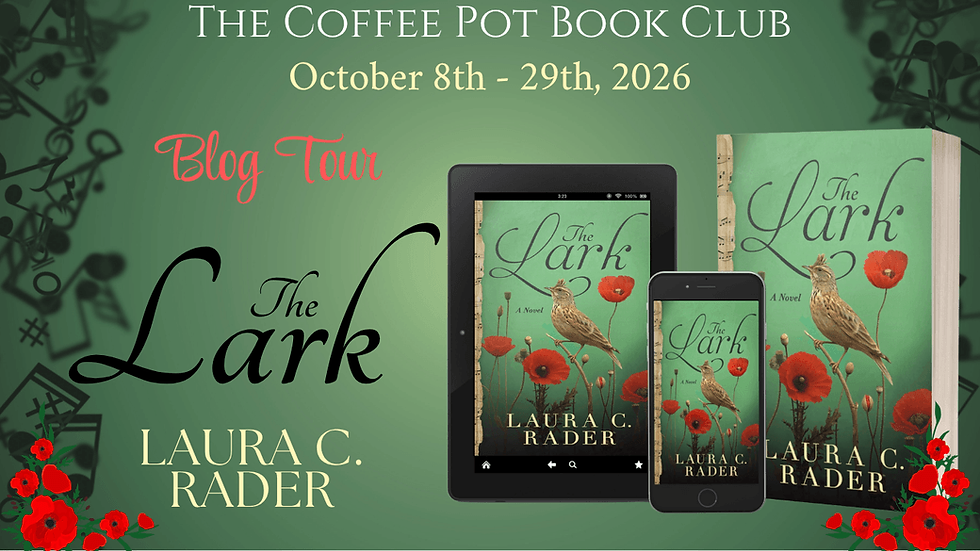
Book details:
Book Title: The Lark
Series: n/a
Author Name: Laura C. Rader
Publication Date: September 23, 2026
Publisher: Echoes Publishing
Pages: 425
Genre: Historical Fiction
Any Triggers: No


@laurawriter2b.bsky.social @cathiedunn.bsky.social

@LCRWriter @thecoffeepotbookclub

@lcrwriter @thecoffeepotbookclub


When The Wizard of Oz graced the silver screen in 1939, it changed cinema and popular culture forever. But the true story began decades earlier with the young composer who risked everything to bring it to the Broadway stage.
At the turn of the century, twenty-three-year-old Paul Tietjens is a gifted classical pianist with dreams of greatness and a non-refundable ticket to Europe to study with the master composers of his time.
But when the bank calls in the debt on his family’s Missouri farm, Paul forgoes his dream to save them from financial ruin. Desperate to find a new road to success, he moves to up-and-coming Chicago, where he persuades author L. Frank Baum to collaborate on a comic opera of The Wonderful Wizard of Oz, setting the stage for the defining cultural touchstone that we know today.
Paul embarks on his opera with high hopes, but scandal threatens his soaring ambition when he falls in love with his best friend’s beautiful but married sister, and his fears grow as the Wizard of Oz demands not only his talent but his soul.
Inspired by Paul’s 1901 diary, The Lark follows Paul as he journeys from the theaters of Chicago to the streets of Manhattan, from his family’s Missouri farm to the beaches of Michigan, fighting to hang onto the chance of a lifetime, his integrity, and the woman he loves.

StoryGraph | Goodreads | Smashbomb | BookBub


The Yellow Brick Road Nobody Knows:
The Real People Behind the First Oz Adaptation.
“Musicals are aunique art form because of their complex synthesis of mediums, such as singing,composing, acting, set design, and costuming, among others. They are arguablythe most complete artistic experience, combining the best craftsmanship ofvisual, musical, and performing arts.”
—Isobel Gibson, Muse Magazine, Volume XX
The demands upon the creative, artistic, and performance teams of a musical, operetta, or comic-opera are immense. It requires a tremendous amount of collaboration amongst many.
Before he authored The Wonderful Wizard of Oz in 1899, Lyman Frank Baum was a journalist, salesman, and dabbler in amateur theater productions. Born in 1856 in New York, he moved to South Dakota in 1888 and started his own newspaper. When it failed after three years, he moved to Chicago to work as a reporter and began writing children’s books
It was most likely there, at the Chicago Press Club, that he met William Wallace Denslow, a man his same age, also a reporter, but more importantly, an illustrator of newspaper and magazine articles, as well as advertising and promotional posters. He and Baum collaborated on several of Baum’s books before their collaboration on the novel, The Wonderful Wizard of Oz.
Enter Paul Tietjens in 1901, a musician twenty years their junior, navigating a new path for his future in Chicago after sacrificing his dream of European piano study to save his St. Louis family from financial ruin. His best friend Ike Morgan shared a studio with Denslow, and had introduced Paul to both Baum and Denslow a year-and-a-half earlier on an expedition to Michigan.
Paul states in his 1901 diary (Newberry Library Special Collections) that both he and Denslow suggested to Baum that he write a libretto for The Wonderful Wizard of Oz, since it was a best seller out of the gate, and Paul, though lacking experience in orchestral composition, was confident his studies at Beethoven Academy of Music in St. Louis would suffice. Plus, he needed some way to earn money so that he could recapture his dream of European musical training.
Baum was the least impulsive and most experienced businessman of the three, and insisted they begin with an original comic-opera, not viewing his American Fairytale as one that would appeal to adults. But nobody wanted their Title Trust, and so he finally agreed to a comic-opera of The Wonderful Wizard of Oz.
Comic-opera was just taking off at that time in America. Blending vaudeville, melodrama and light opera, it was entertainment for the masses. None of the three had much experience with this new performance art, but fortunately, they found a director who was a wizard at it: Julian Mitchell. When the trio approached him in late 1901, he had staged and directed more than half a dozen musicals, working with the renowned Weber and Fields of Broadway.
Contracts were signed and lead actors secured. Mitchell undertook major revisions and rewrites of Baum’s script, eager to turn a simple comic opera into an extravaganza, swapping out Toto the dog for Imogene the Cow, adding a rival for the Wizard and creating several new characters and subplots, and eliminating the Wicked Witch of the East. As these changes were made, Baum and Tietjens were kept furiously busy writing additional dialog and composing new music.
The whole thing might not have worked if not for the cast. Mitchell managed to secure the already popular stage acting team of Fred A. Stone and David C. Montgomery, triple-threat actors/singers/dancers with great chemistry. And the pretty Anna Laughlin, a newcomer to Broadway and only 19 years old, was cast as Dorothy, perfect for the character who was now re-envisioned as a young woman in love.
Crises arose and were resolved. Paul Tietjens cracked under the pressure a few months before the premiere set for June 1902 in Chicago, and Mitchell brought in A. Baldwin Sloane as a “fixer”. Sloane was only a few years older than Tietjens, but he was already a prolific Broadway songwriter, and capably filled in the musical gaps. Baum was also overwhelmed with creating numerous one-liners, and Mitchell entrusted much of that to Glen MacDonough, the son of a theater manager and actress.
While Denslow worked on costumes, Mitchell employed Walter Wilcox Burridge for backdrops, sets, and special effects. Burridge had worked extensively for the Chicago Grand Opera for nearly a decade, and was also an accomplished landscape painter, specifically of Yellowstone and Yosemite National Parks. He was able to create the worlds Baum imagined and lent them a sense of majesty.
The rest, as they say, is history. After several delays, The Wizard of Ozextravaganza opened at Chicago’s Grand Opera House in mid-June 1902. It played to sold-out audiences through September, before touring the Midwest and finally premiering in January 1903 at Broadway’s Majestic Theater, where it racked up 293 performances to become the best-selling show of the year.
It had an A and B tour nationally from 1903 to 1905, the A tour with the original cast and sets, and toured with a new company from 1906 to 1909 before finding its way to regional theaters from 1911 to 1918.
W. W. Denslow passed in 1915, and L. Frank Baum in 1919, but Paul lived until 1943, long enough to see the 1939 MGM movie. His brother made a bequest to Washington University in St. Louis in Paul’s name, which was used for the Paul Tietjens Memorial Music Studio dedicated in 1975, and Tietjens’s three-hundred compositions are preserved in the university’s Olin library special collections. The university also has an endowed faculty chair position, Paul Tietjens Professor of Music, currently held by musicologist Todd Decker.
Paul Tietjens’s diaries, spanning the years 1901 through 1942, were donated to the Newberry Library in Chicago by his daughter, Janet Tietjens Hart, which is where the author Laura C. Rader discovered them in 2021, and began researching and writing her novel, The Lark.


Laura C. Rader is the award-winning author of the biographical historical novel Hatfield 1677. When she isn’t writing, you can find her conducting research, playing her 1905 antique piano, and spending time with her family, friends, and pets.
A native of Southern California, she now lives north of Raleigh, North Carolina.
Author Links:
Website: https://www.lcrwriter.com
Twitter / X: https://x.com/LauraCR_Author
Facebook: https://www.facebook.com/LCRWriter
Instagram: https://www.instagram.com/lcrwriter/
Threads: https://www.threads.com/@lcrwriter
Pinterest: https://www.pinterest.com/laurarader8/
Amazon Author Page:
Tour hosted by: The Coffee Pot Book Club




Comments