


Guest Post: Enheduanna's Song from the Sands by Ellen Rachlin



Book details:
Book Title: Enheduanna’s Song From the Sands
Series: n/a
Author Name: Ellen Rachlin
Publication Date: August 25th, 2026
Publisher: Histria Fiction
Pages:272
Genre: Historical Fantasy/Historical Literary Fiction
Any Triggers: SA (potentially distressing content)


@thecoffeepotbookclub

@ellenrachlin @thecoffeepotbookclub


Discover the untold story of Enheduanna, the world’s first named author, as she navigates power, betrayal, and divine destiny in ancient Mesopotamia. A mesmerizing fusion of history, myth, and female leadership that challenges how we see the past—and ourselves.
A high priestess dethroned. A rebel with a dangerous plan. One empire hanging by a thread.
When Enheduanna is named High Priestess of Ur, her connection to the gods makes her a target. Lugalanne’s coup strips her of robes, power, and home, casting her into the perilous underworld. There, amid forests of shadows and treacherous trials, she discovers that divine favor alone won’t save her—only cunning, courage, and a willingness to embrace the ruthlessness of her enemies can restore her.
Drawing on history and myth, Enheduanna’s Song From the Sands follows the world’s first named author as she fights to reclaim her voice and her destiny. Political intrigue, betrayal, and divine tests collide as Enheduanna must decide whether to forgive, to fight, or to harness the power that could shake the foundations of an empire. For readers who love The Song of Achilles’s intimate heroism, Circe’s mythic depth, or The Daughters of Sparta’s fierce women, this is a mesmerizing dive into ancient Mesopotamia where courage and cunning are the only paths to survival.

Bookshop.org | StoryGraph | Goodreads | Smashbomb | BookBub


"In finely detailed prose, Ellen Rachlin brings Enheduanna, daughter of Sargon, to life, as well as the mythic figures of Inanna and Ereshkigal of the Underworld. Enheduanna’s Song From the Sands is filled with conflict and intensity, each quest, not only a matter of achieving power, but of life and death."
~Regina McBride, author of Stranger from Across the Sea
"Ellen Rachlin’s sumptuously detailed debut novel Enheduanna’s Song From the Sands tells the remarkable true story of the ancient high priestess Enheduanna. Rachlin guides us through the intrigues, secrets, spies and wars of Enheduanna’s times, bringing this gifted woman and the goddess she served to life. What’s so singular about this heroine? Daughter of a king, a spiritual leader and a poet, she signs her hymns with her own name. In Enheduanna’s Song From the Sands the first known author in western recorded history is a gutsy woman! Thanks to Rachlin’s imagination and rich research, I fell in love with Enheduanna and relished her anguished and opulent story."
~ Molly Peacock, Author of The Paper Garden: Mrs. Delany Begins Her Life’s Work at 72
"Enheduanna's hymns to the goddess Inanna are the first known literary works to name an author. Rachlin brings her to life in this novel set in 2300 BCE, a novel of sex, war, love, a baby in a basket, and a woman creating a new order of being. It’s historical fiction writing that reminds the reader of Hilary Mantel, you can’t put it down. You want to follow the priestess to bed, to rise, to her last fighting breath. Rachlin won’t let you put this book down."
~Kate Gale, author of Under a Neon Sun and Swimming the Milky Way
“I could not put this book down! As a history buff I always love reading historical fiction and this book was so amazing. Reading Enheduanna’s struggle and overcoming hardships as a high priestess were so inspiring and intriguing to read about. If you loved books like The Song of Achilles than you would love this book as well.”– Elda Rastoder Net Galley Reviewer
“I'm OBSESSED. This is a rich and beautiful story of stepping into power and making hard decisions, told with a wonderful, brilliant voice perfect for its historical setting. The blend of intense drama, action, and conflict/reflection with oneself and the world around was executed so well. I really liked the addition of the footnotes and references because they tied this fantasy story in with real history, that was a smart addition. I fell in love with Enheduanna and the ancient high priestess' intricate story and I simply could not put this book down. I'd recommend this book to anyone who loves ancient history and feminist retellings of true stories.”
~ Seeta Net Galley Reviewer
“A historical fiction about an almost forgotten but formidable high priestess in Ancient Mesopotamia. Enheduanna is the daughter of the king Sargon, and has been destined to become high priestess since receiving visions of a goddess from a young age. After a brutal SA on her journey, her desire for power turns hungry from wanting revenge. She experiences isolation, punishing rebels and mastering her intimidation. Learning that seeking divine power is not the way, she begins to once more find alignment with values and creation, which led her to become high priestess in the first place. Tracing the course of Enheduanna’s rise to power, many important aspects of Mesopotamia 2300 BCE mythology and Enheduanna’s life are explored. Enheduanna was such a powerful FMC in this book and woman in real life, I’m truly so grateful to have learned about her. Ellen Rachlin’s writing captures the powerful and divine moments of Enheduanna’s life and suspends them before you so you may be there right alongside.”
~ Morgan ARC reader
“Enheduanna’s Song from the Sands is a historical fantasy surrounding the life and actions of Enheduanna, the daughter of Sargon the Great and High Priestess of Ur, a powerful religious and business leader who lived approximately two-thousand years before Virgil. Ellen Rachlin entwines her history with myth in a novel about the world’s first named author, who finds herself the focal point of conflict, transformation, and choices surrounding an extraordinary power rising in ancient Mesopotamia.
From the start, the first-person story builds an evocative, compelling scenario that draws readers with passion and insight:
Inanna, supreme in Heaven and Earth, ruler over all gods, I beg of you: restore me to my temple, bring me home! In the ancient city of Ur, I no longer breathe the salty air, lift myself from the sacred bed or unravel Ningal’s dreams for my followers. The southern stars have slipped away from me; Now I walk the thorny brush of the northern mountainside. As I sing your blessed song, I am dying.
A host of equally memorable characters enter Enheduanna’s life and chambers, from Darda, the son of Purushanda’s former king, to her mother and father, Sargon and Tashlultum, Uanna and Nidintu, women who are part of a core circle Enheduanna thinks she can trust, and others from different sides of an evolving rebellion.
Enheduanna tries to fulfill her destiny, but often winds up feeling isolated and uncertain:
“...in this forest of knowledge, the faces of some of my closest friends are becoming increasingly obscured.”
As Enheduanna faces riots, rebels, and intrigue, her world comes to life with a host of social, political, and personal issues; all of which she navigates with authority and, sometimes, uncertainty: “I fear we’re losing real ground to our enemy.”
Suffused with rage, she then documents the history of her world in vivid detail that readers will find engrossing and realistic.
Librarians and readers seeking a story of ancient history come to life will find Enheduanna’s Song from the Sands rich with detail, personalized by the protagonist’s reflections as she steps into her power and makes difficult choices.
Filled with dramatic action and confrontations with self as well as the outside world, Enheduanna’s Song from the Sands will appeal both to leisure readers and scholarly students of ancient times. The former will appreciate the high drama and personal touches; the latter the footnotes and references which cement events and fantasy in a layer of real history.
An important footnote by the author clarifies why this novel should be in any serious collection of women’s history, as well as in fantasy and historical fiction holdings:
I stumbled across Enheduanna while researching Sargon the Great. No one I knew, including poets, had ever heard of her or her hymns. When I began to uncover what was more broadly known about Enheduanna, it astounded me that the first-named author in history was not only a virtual unknown, but a woman who lived in a male-dominated culture.”
~ Diane Donovan Midwest Review on recommended reading list

Desert, Temples, and Shadows: The Real Places That Inspired the Book
The Ziggurat of Ur inspired my novel. It was the seat of power for Enheduanna, the daughter of Sargon the Great, high priestess, and world's first named author. And this place was not desert then but rich marshland fed by the Euphrates river.
On the outskirts of Nasiriya on the lower Euphrates, Ur is a landlocked village with a different name. At its center lies the iconic Ziggurat of Ur and surrounding it is the skeleton of ancient structures: a mausoleum, Temple of Nanna, priest and priestess residences, city walls, and other structures, bones from another civilization not often spoken of but glorious, nonetheless.
What Ur once was, but difficult to see now, inspired me to bring it alive reaching back into Enheduanna's time. Earlier this year, in the middle of an Iraqi desert, major reconstruction began on the ziggurat of Ur, a mammoth iconic ancient Mesopotamian temple structure, built to honor the moon god, Nanna or Sin, a key deity. The last major reconstruction was thousands of years ago in the 6th century BCE by the last Neo-Babylonian king, Nabonidus. But he saw a very different structure—one that was surrounded by fertile farmland, rivers nearby and canals running through a thriving city-state, not the desert we see today. This was Enheduanna's world.
But the landscape changed. The rivers shifted, abandoning the mighty Ur in the heart of ancient Sumer. This civilization lasted over 2,000 years before becoming nearly a footnote in history. If the temple hadn't been touched at all, the remnants of its glory would still rise from the sand despite the fact that people, structures once part of the city of Ur, and its surrounding rich farmlands had abandoned the temple long ago.
The ziggurat's remnants inspired much of my novel. It was Enheduanna's home, the place from which she either wrote or served her people so memorably that ancient literature treasures were attributed to her. The gods were infused into every aspect of the ancients' lives. Pleasing at least some of the members of the pantheon was the only way to survive. When Enheduanna is forced into exile by a mortal rebel leader, only the god, Inanna, could restore her, or so it reads in the great hymn, The Exaltation of Inanna. Enheduanna pleads for Inanna's favor.
The modern ziggurat of Ur allowed me to imagine an empire of city-states and other grand ziggurats, including the most central one, the one in Nippur. According to legend, at the rise of the Akkadian Empire, Sargon the Great, Enheduanna's father, is said to have chained his enemy to the gates of the temple and brought him to Enlil, its reigning deity. Kings made offerings to the gods through the temples as a matter of course, especially after conquests. And kings flexed their connection to the gods by rebuilding ever more elaborate temples over existing ones.
The Temple of Ur's survival demands fond memories of the great civilization that created it. It is impossible to see it and not wonder about its glorious past. The most iconic leader of the Temple of Ur was Enheduanna. She and her temple were left behind in history.
Ur needs to survive as it was the birthplace of so many aspects of our modern culture including literature, law, education, farming, myths, government and more. Ur was the civilization that shaped us.



Ellen Rachlin’s poetry has appeared in American Poetry Review, Comstock Review, Granta, Court Green, Literary Imagination, and various anthologies. She has published two collections of her poems, Until Crazy Catches Me (Antrim House, 2008) and Permeable Divide (Antrim House, 2017), winner of the 2018 IBPA Benjamin Franklin Silver Award.
She has a historical fiction novel, Enheduanna’s Song From the Sands, based on the life of Enheduanna, the Akkadian high priestess and world’s first-named author, forthcoming from Histria Books and a collection of poems, At the Big Bang Resort, forthcoming from Red Hen Press.
She is also the author of two chapbooks, Waiting for Here (Finishing Line Press, 2004), a finalist in the New Women's Voices series, and Captive to Residue (Flarestack Publishing, 2009). She received her MFA from Antioch University. She serves as Treasurer of The Poetry Society of America and is a partner at Blue Leaf Ventures.
Other writing genres include numerous textbook and journal articles on the subject of finance and investing with various publishers including Wiley.
Author Links:
Website: https://www.ellenrachlin.com/
Instagram: https://www.instagram.com/ellenrachlin/
Amazon Author Page: https://www.amazon.com/stores/Ellen-Rachlin/author/B002LFQWRM
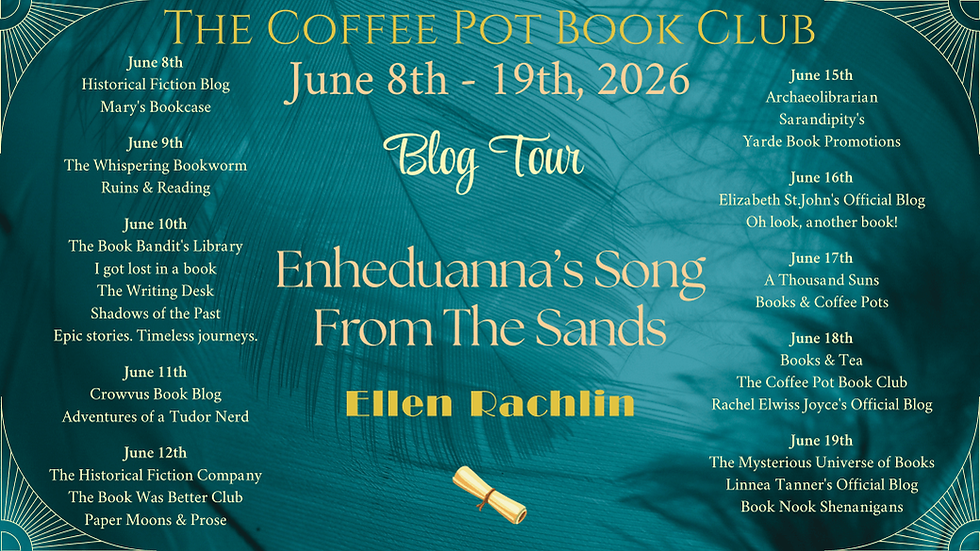
Tour hosted by: The Coffee Pot Book Club


Thanks so much for hosting Ellen Rachlin on your lovely blog today, with such an interesting post about her inspiration for Enheduanna’s Song from the Sands. Take care, Cathie xx The Coffee Pot Book Club